Two items of considerable interest were found on Australian stamp auction sites. The first was a rare cover with faint markings dated 5-SET 1930/ PARAGUAY of the first internal flight from Ascunsion to Colonia Nueva (New) Australia (as an arrival cds) franked with 2 Republic of Paraguay stamps (Scott 288, 291), total postage of P2.50 (Peso), and the stamps were postmarked in a diamond with ‘ENSAYO/ SEVICIO/ AEREO/ INTERNO’. It was addressed to Norman Stocky/ JEFE CORREOS/ COLONIA NUEVA AUSTRALIA (Figure 1).
Enlargements of the stamps and their diamond cancellation, as well as the COLONIA NVA AUSTRALIA/ 5- SET 1930/ PARAGUAY postmark are shown in Figures 2 and 3.
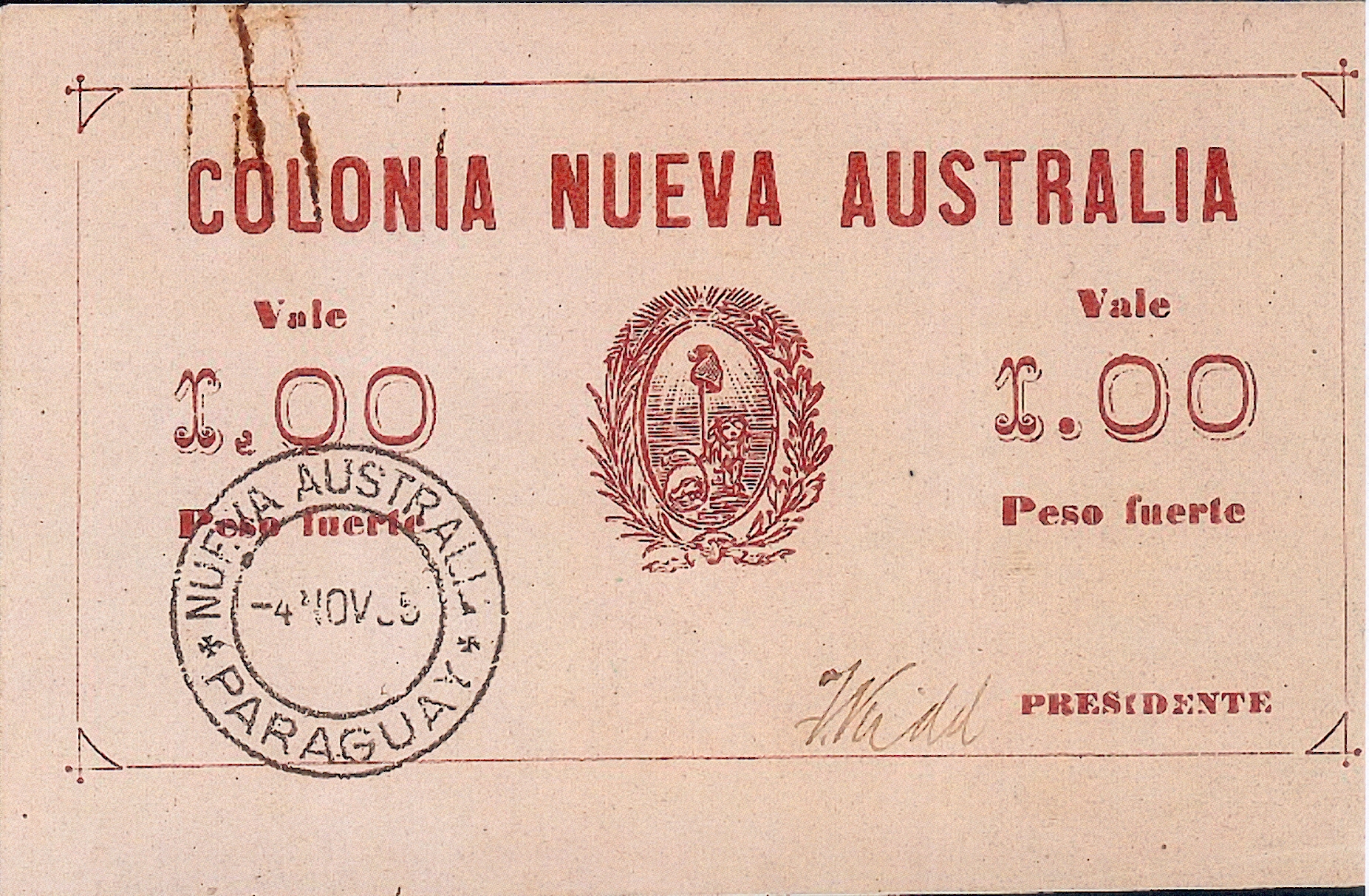
The second item not of philatelic origin was listed under ‘Australian Colonial Banknotes’ as: 1895 (May) 1.00 Peso fuerte inscribed ‘COLONIA NUEVA AUSTRALIA’, clasped arms type, signed ‘H.S. Watson‘ in pencil on the reverse [two known in private hands] AUD 5,000. This is signed at lower right, F(rederick) Kidd, PRESIDENTE (Figure 4).
One of the more famous incidents in Australia’s history concerns the colony of New Australia in Paraguay. This colony, its development, and the departure of the colonists from Australia caused much discussion when it occurred during the 1890s. The colony is of interest to numismatists, because paper money was issued in the colony.
The ‘New Australia Co-operative Settlement Association’ was founded in 1891 by William Lane and a group of Australian socialists in an attempt to prove that socialism could work. Founded amid the turmoil of strikes and depression, members of the Association decided to leave Australia, to escape the government, the pastoralists and the wealthy, who were making it miserable for the working man. It was decided by members of the Association to seek freedom in a new country and, ultimately they were granted a tract of land in Paraguay.
Paraguay was a Spanish possession from 1535 until 1811 when it gained independence. In 1890 Juan Gualberto Gonzalez was elected as President. There was a severe economic recession in Paraguay and Gonzalez became a strong advocate of immigration as a tool to recover from the recession and to repopulate the nation, which is why he welcomed the colonists of New Australia. The land grant was dependent on a certain number of people settling in the colony within a given time.
In Australia, the news of the offer was welcomed and preparations were made for the first of numerous voyages to take colonists to Paraguay. To facilitate the voyages, the Association acquired a ship named the Royal Tar, which commenced its first voyage from Sydney on 16 July1893. The vessel and first batch of 220 colonists arrived in Montevideo on 11 September prior to the proceeding to Asuncion, Paraguay, where they arrived on 22 September. The specific tract of land to be used by the colonists was selected, a settlement was founded, and the pioneers commenced the hard work of establishing New Australia.
It immediately became apparent that William Lane, who had been elected to head the colony, expected the settlement to work on his principals rather than on principals guided by the colonists. He had forbidden alcohol, refused any but white inhabitants at the settlement, and insisted on the sanctity of marriage. He also discouraged fraternizing between the colonists and the local population. Although the rules of the New Australia Co-operative Settlement Association stated that it did not recognize any religion, Lane proved to hold very narrow and strict religious beliefs. It was not long before a schism occurred amongst the pioneers. Lane expelled some colonists and others left of their own volition.
The second voyage of the Royal Tar left Adelaide on 31 December 1893. Shortly after its arrival in Paraguay in 1894 the schism at New Australia became irreversible. In May 1894 Lane took his followers and established a colony at Cosme some 72 km further south, while the rest of colonists remained at New Australia. The newly elected leader of the New Australia colony was Frederick Kidd, who had arrived in the second group of colonists, and whose name, as President, appears on the money note in the last figure.
The struggle by the colonists to make progress was hampered by political developments in Paraguay. On 9 June 1894 President Gonzalez was overthrown, and ultimately, the New Australia Colony fell into difficulties, with crop failures and an unstable set of settlers. When the stability of the New Australia colony initially became a concern, the Paraguayan government commenced a subsidy for the colony. The subsidy ceased when President Gonzales was overthrown, the original agreement between the Paraguayan government and the colony was cancelled because the promised one thousand settlers had not eventuated.
In January 1897 the communal assets of New Australia were auctioned and the proceeds divided amongst the remaining colonists. The Paraguayan government then allowed each settler to take up a small landholding, with many of the settlers proving to be successful farmers over a period of time; although many of the colonists later moved to towns and cities in Paraguay and Argentina. The colony at Cosme remained viable for many more years, finally breaking up into individual holdings during 1909. The final document certifying the breakup of Cosme was signed on 12 August 1909.
There are four different types of notes and three known denominations for the notes issued in New Australia. Notes of all types have Colonia Nueva Australia (Colony of New Australia) at the top, a vignette in the centre, the value of the note at the left and right, the signature of Frederick Kidd signing as Presidente, and a date stamp. The date stamp is circular, with the words Neuva Australia Paraguay in the rim of the stamp and the date in the centre. The four types of notes can be classified according to their vignettes as follows: Clasped hands with bare arms; Clasped hands with cuffed arms; The Lion and Phrygian Cap; Arms with Eight Flags. The note shown in Figure 4 is of the type ‘Clasped hands with bare arms’.
Writer Mary Gilmore (1865–1962), then Mary Cameron, was a colonist. She taught Cosme’s children, married fellow settler, William Gilmore and had a son. Like most of her fellow colonists she quickly became disillusioned, and returned to Australia in 1900. She also edited Cosme Monthly, and compiled The Worker Cook Book. In 1899, Lane left Cosme for New Zealand, becoming a conservative journalist and editor of the New Zealand Herald.
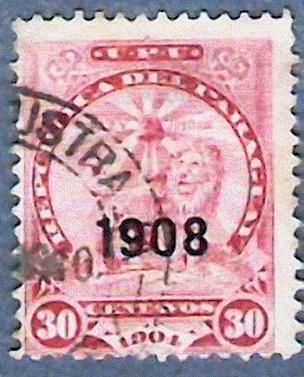
A late addition to this paper is a Paraguayan stamp used in Colonia Nueva Australia which is the 30c Scott #178 ‘Sentinel lion at rest’ with the 1908 overprint postmarked “(NUEVA A)USTRA(LIA) in a double circle (Figure 5).
Acknowledgment: This paper relies heavily on Peter Symes’ excellent website, and is a much abbreviated version of: http://www.pjsymes.com.au/articles/NewAustralia.htm
Addendum: The cover in Figure 1 has not sold over a period of at least a year, and it has appeared on another Australian auction site with a price tag of AUD 1,200 to 1600. The reverse of this cover is shown for the first time, and the sender is identified in a red oval as NORMAN STOCKS/ SAN JOSE 17(9?)/ ASCUNCION – PARAGUAY (Figure 6).
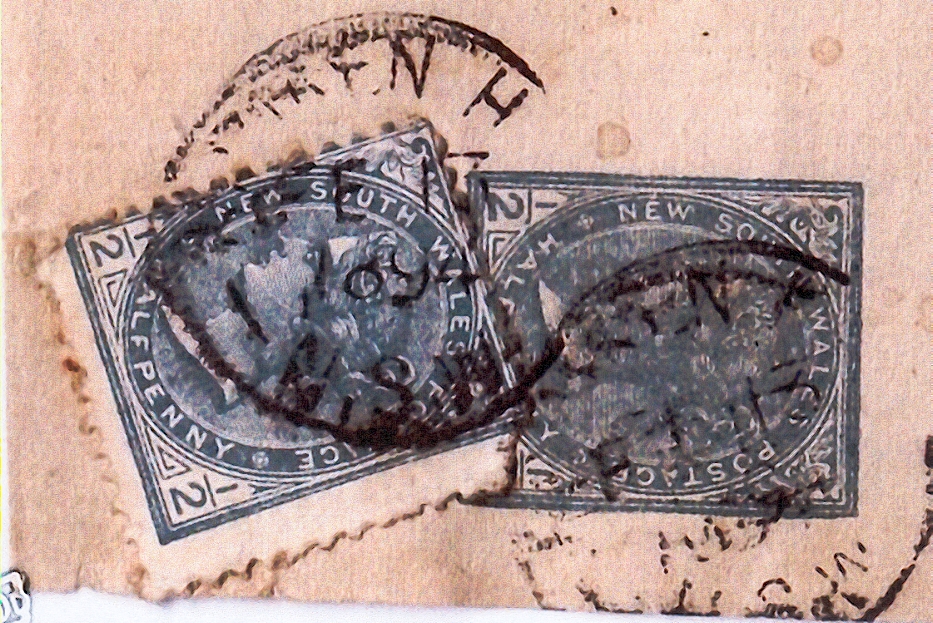
Addendum (August 2009): This New South Wales ‘Half Penny’ wrapper has a half-penny stamp added. It is addressed to Mr. H.G. Watson, New Australia Settlement, Paraguay, South America. Paraguay would be very uncommon. and the Australia Settlement is extremely rare, especially on a N.S.W. wrapper (Figure 7).
.jpg)
At a higher magnification, the stamps are cancelled BROKEN HILL/ FE 13/ 1894/ N.S.W. (Figure 8).
Mr. H. G. Watson, as for most of the people who migrated to Paraguay, is not named in any of the papers I have researched.
Addendum (November 2010): I have just seen a paper written by Ronald M. Lee in the Australian Journal of Philately 2007 No. 102 titled ‘The Last Cancellation from the Australian Settlement Colone Cosme’, which describes the Colone Cosme established when in 1896 the disillusioned William Lane broke away from Colonia Nueva Australia with some of his followers. This colony also was not a great success and was disbanded in 1904. The situation of the 2 Australian colonies in are Paraguay are shown ( which also show the capital of Paraguay, Ascunscion) in his drawing of the map (Figure 9).
Ronald Lee shows two postmarks for Colonia Cosme, the first used in ca.1903 and the second in 1961 . Even though the Colony no longer existed in 1961, a post office was still operating using a Colonia Cosme cancel (Figures 10 & 11).
Ronald continues as follows: “After the cessation of the colony the numbers of the residents fell dranatically. In 1901 there were 44 adults (at Colonia Nueva),but by 1908 it had fallen to 9 men and 5 women.”
I acknoweledge that this is an abbreviated version of Ronald Lee’s paper (reference cited above).
Addendum (February 2011): Two more examples of the “banknotes” for the colony have been seen. The first is similar to Figure 4 with a difference in the value, the original ‘Peso Fuerte’ vs. the present ‘0.01 Centavos’ (Figure 12).
The next is different in style and quality and is valued at 1.00 Peso fuerte. (Figure 13).